When an older, frail patient needs emergency surgery, the operation is the surgeons’ job. The medical side is everything that decides whether they get through it: scoring frailty, treating what can be treated, agreeing with the patient what they want, and bringing in the geriatric team early. In the latest national audit, four in ten of the patients who should have had that input got it. Six in ten didn’t.
I’m a physician on the surgical team in Oxford. I look after the medical side of patients who come in acutely unwell under the surgeons, and this is what that means in practice.
Who we’re talking about
In the National Emergency Laparotomy Audit (NELA), 11,785 of the 21,324 patients having emergency bowel surgery were aged over 65. That’s a little over half (55.3%, my calculation from the report’s two figures), in one year (24 April 2024 to 31 March 2025, the eleventh report, published October 2026).
Age isn’t frailty. A man in his 80s with a bowel obstruction, who lives alone and walks to the shops every day, may be fitter than a frail man in his 70s. NELA counts a patient as living with frailty at a score of 5 or more on the Clinical Frailty Scale, and a third of those over 65 (33.6%) were. The question I ask first is what they could do a fortnight ago.
What the medical side does
The decision to operate is made by the surgical team with the patient. We help them see the whole picture.
At the front door that means assessing the patient alongside the surgeons and anaesthetists, then looking after the medical problems that raise the risk. That can mean fast AF, an AKI (acute kidney injury) or medicines that need changing, such as anticoagulants. It also means working out early who is at risk of delirium, and talking with the patient and family about what a good outcome looks like for them. Sometimes the answer is that they’d rather not have the operation, and that’s a legitimate outcome too.
After the operation the same work carries on, and the geriatric team joins in. Nobody on the team does this alone. Surgeons, anaesthetists, nurses, pharmacists and geriatricians each do part of it.
What the national audit shows
The newest report (the eleventh, April 2024 to March 2025) looked at how often older patients get a frailty assessment and specialist review.
- 68.4% of patients over 65 had a formal frailty assessment recorded. That’s down from 73.6% the year before.
- Of the patients over 65 and living with frailty, or over 80, 39.6% (2,111 of 5,329) were reviewed after the operation by a team with expertise in comprehensive geriatric assessment, most often a geriatrician-led service. It was about 40% in England and Wales, and 13.0% in Northern Ireland.
- Patients over 65 with no frailty assessment recorded had a mortality rate of 11.1%, almost double that of patients not living with frailty. The report’s reading is that no assessment doesn’t mean no frailty.
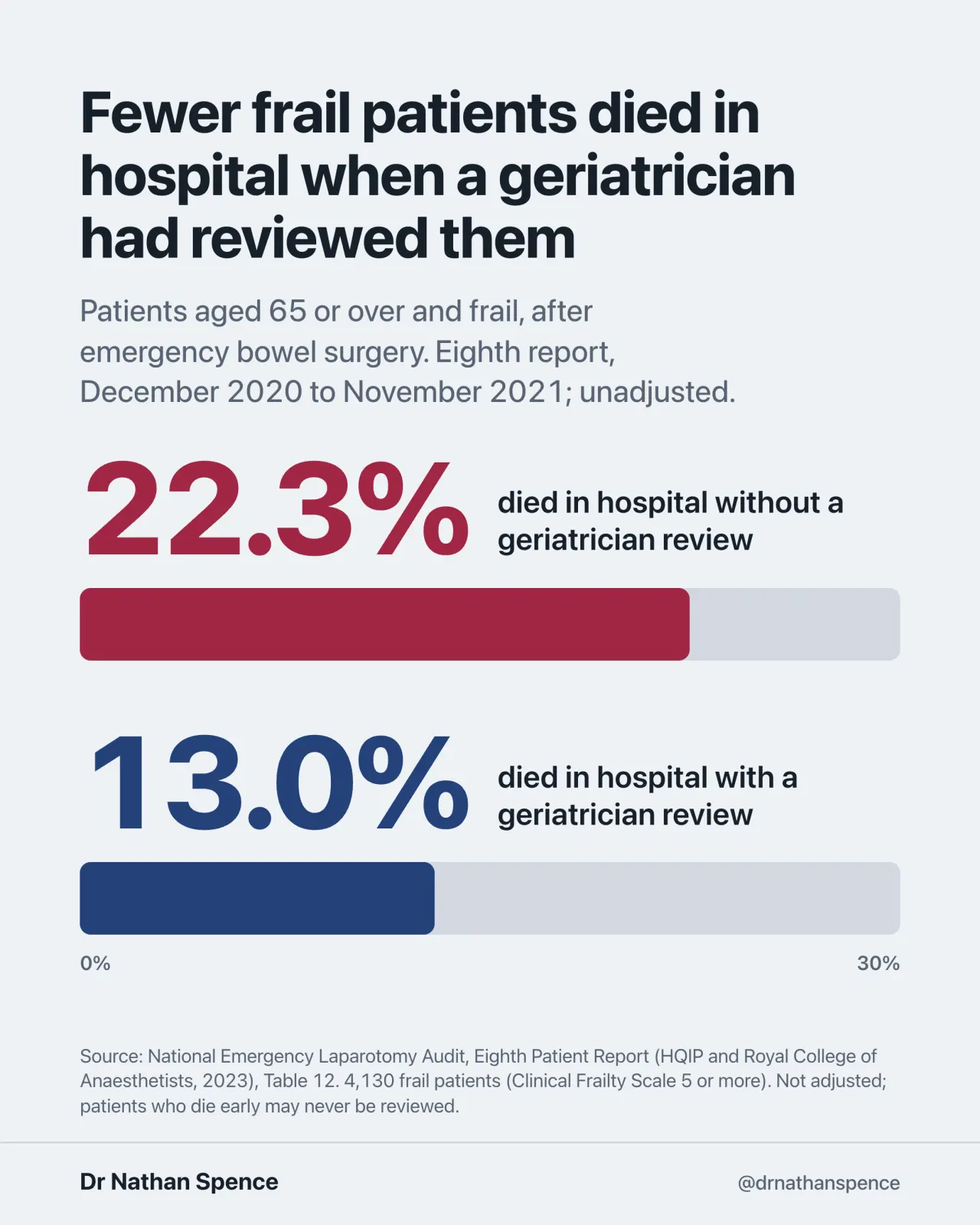
The eleventh report doesn’t give mortality by geriatrician review. The last report that did was the eighth (patients treated December 2020 to November 2021). Among patients aged 65 or over, in-hospital mortality was lower when a geriatrician had reviewed the patient.
- Frail patients: 13.0% with geriatrician review, 22.3% without.
- Non-frail patients: 5.9% with review, 9.5% without.
Frailty roughly doubled the risk of dying in hospital in the eighth report: 13.0% against 5.9% among the patients who had a review. At the time the audit called geriatrician involvement the poorest achieved standard it measured.
The eleventh report is more cautious about benefit. It found no clear trend in length of stay by how often a hospital used specialist review, and said longer stays may reflect review being aimed at the most complex patients.
What the guidelines ask for
In its eighth report NELA recommended a formal frailty assessment for every patient aged 65 or over, and that surgeons, anaesthetists and intensivists take frailty into account when they estimate risk. The NELA risk score didn’t include frailty then. In the eleventh report, two in three patients over 65 (68.4%) had one recorded.
The Centre for Perioperative Care and the British Geriatrics Society published a guideline on the perioperative care of people living with frailty in September 2021. At launch it was described as the first full pathway guideline for this, written with more than twenty organisations. NICE’s guideline on perioperative care (NG180, 2020) also lists frailty among the things to take into account when planning pain relief.
What these figures don’t tell us
The 13.0% and 22.3% figures are from the eighth report. They’re unadjusted. A patient who dies early may never reach a geriatrician review, which flatters the group that had one. The audit says so itself. NELA also doesn’t check the frailty scores hospitals record. The figures cover the whole audit, so they don’t describe any single hospital, and they’re not about my own unit.
The gap between what the guidelines ask for and what patients get is still large. And frailty tells you at least as much as age.
If you’re writing about this
I comment on emergency surgery in older and frail patients, on what the medical side of surgical care involves, and on why age on its own is a poor guide. I do TV and radio news, documentaries, podcasts and longer interviews.
Email hello@drnathanspence.com or send a media request.
If you’re worried about someone, speak to their team, ring 111, or 999 if their life is at risk.