“Is he fit for surgery?” is the question I get asked most. It’s usually the wrong question.
It wants a yes or a no. Honestly, almost nobody having major surgery is a clean yes, and not many are a flat no either.
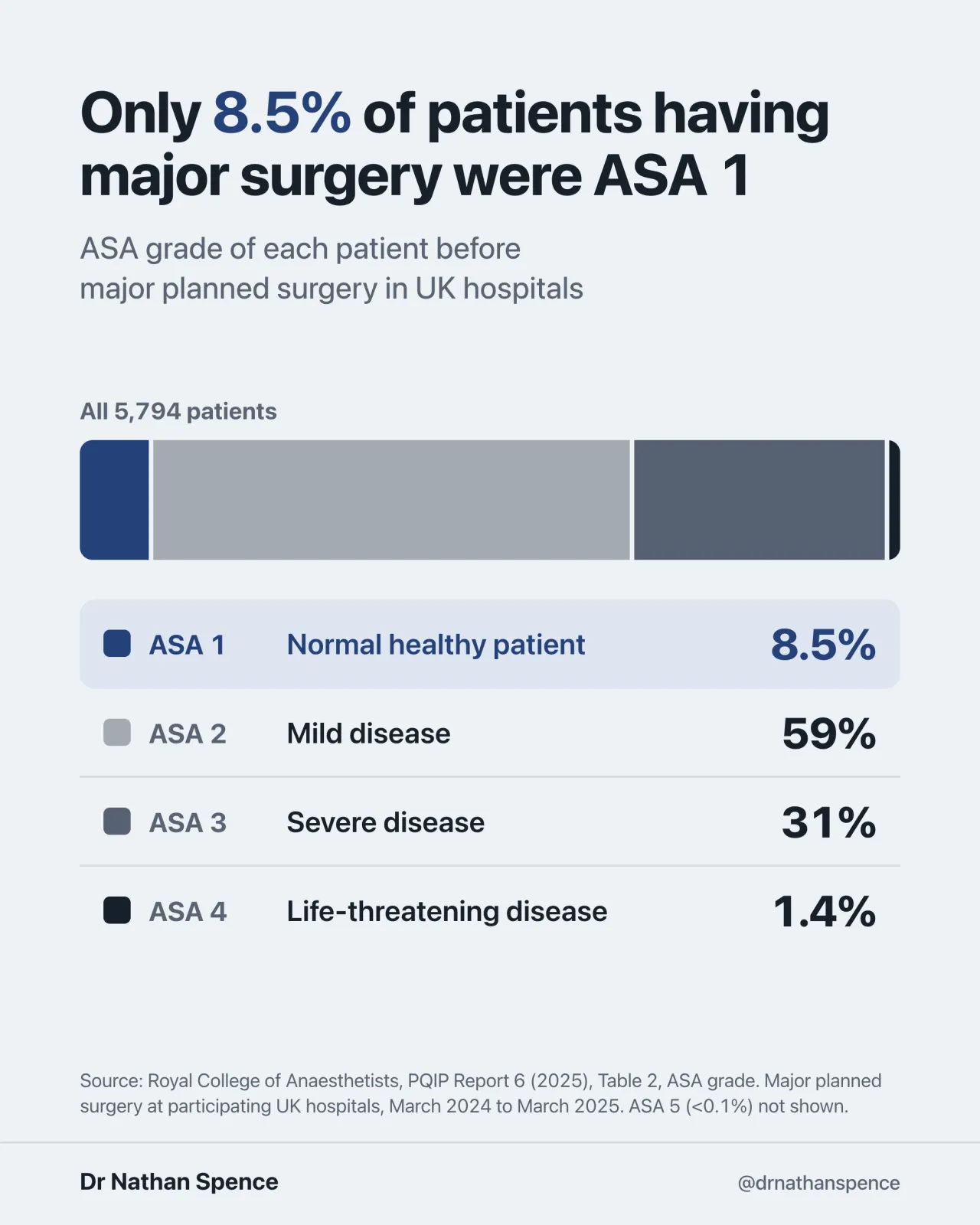
The Royal College of Anaesthetists’ PQIP study tracks major planned surgery in participating UK hospitals. In its 2025 report, covering 5,794 patients, only 8.5% were graded ASA 1, a normal healthy patient. The rest had something going on, and nearly a third were ASA 3, severe systemic disease.
If fit meant healthy, more than nine in ten of them wouldn’t have qualified.
And a yes doesn’t mean safe. On day 7 post-op, 15% of the same patients had a complication, and 11% had a major one, Clavien-Dindo II or above.
“Fit for surgery?” doesn’t cover cholecystitis in a 75-year-old on anticoagulants with a reduced ejection fraction.
Part of my job is helping the team answer it. So what do I say instead?
It’s a conversation. These things always are. I talk the team through the risk for this operation, with a number if there’s a score for it, and what we can fix before theatre if there’s time. Then whether it’s worth it to the patient, which means asking them.
That’s a longer answer than “fit”. But “fit for surgery” in the notes tells the next doctor almost nothing. A risk and a management plan tell them what to watch for and what to do.
Sometimes the answer really is no. Someone too unwell for the operation they need, or an operation that won’t give them what they want from it. That conversation goes a lot better when the patient has been hearing about risk since the first review, not for the first time at the end.